Trusting the Read with Pocket Tens
Fish & Chips – Hand of the Week
Trusting the Read with Pocket Tens
Game: Live $1/$2 NLH
Structure: UTG Straddle
Hero: Small Blind
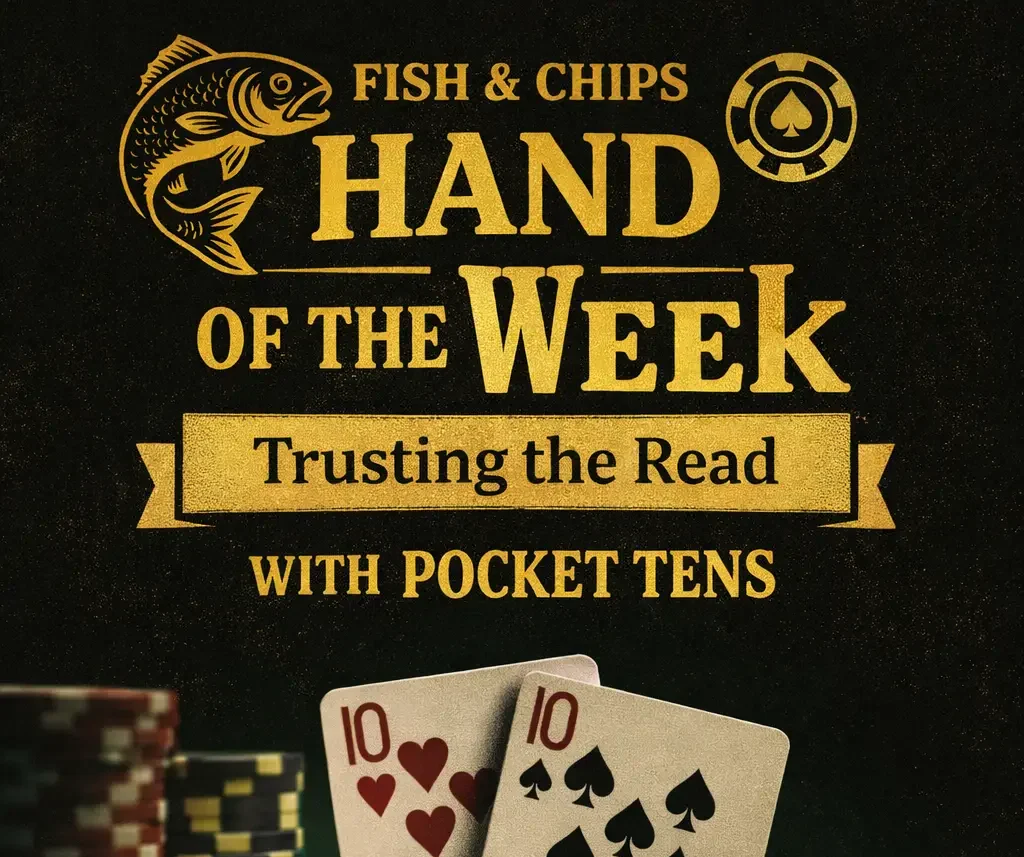
Hand: T♠ T♦
Preflop
The game is playing with a UTG straddle, which immediately inflates the pot and loosens ranges around the table. Several players limp and the action gets to me in the small blind.
I look down at TT.
With multiple limpers already in the pot, I decide to raise to $25 to isolate and take control of the hand.
Unfortunately, this is live $1/$2 and raises don’t always accomplish what we hope.
Four players call.
We go five-way to the flop.
Preflop Analysis
Pocket Tens is a strong hand in this spot, but the main strategic goal from the small blind should be:
Reduce the number of players.
The challenge is sizing.
When there are multiple limpers in a straddle pot, the correct raise size often needs to be much larger than players expect.
A good rule live is:
$10 + $10 per limper
With four limpers already in, a raise closer to $40–$50 might actually perform better.
The $25 raise is still reasonable, but it allows too many players to continue and forces us to play out of position in a multiway pot, which is rarely ideal.
Flop
Board: 7♦ 4♠ 3♣ (rainbow)
A very favorable board for pocket Tens.
No overcards and the texture is fairly dry.
I lead out for $75.
One player folds.
Another player immediately moves all-in.
Everyone else folds and the decision is back on me.
Flop Analysis
This is where the hand gets interesting.
First, let’s look at the bet sizing.
With five players seeing the flop, the pot is already fairly large. Betting $75 applies pressure to:
- Overcards like A K / A Q
- Middle pairs
- Straight draws such as 65
It also protects against hands that might pick up equity on later streets.
This is a good example of a multiway protection bet.
In multiway pots, betting larger with strong hands is often correct because:
- Players call lighter
- Draws have more equity
- The pot grows quickly
Facing the All-In
When the player shoves, the key question becomes:
What hands realistically take this line?
Possible value hands include:
- Sets (77, 44, 33)
- Two pair (unlikely)
- Overpairs like 88 or 99
- Straight draws like 65
- Occasionally random bluffs
But this is where live poker reads come into play.
The player gave off a tell that suggested weakness.
Live tells are never perfect, but when combined with board texture and betting patterns, they can push a marginal decision toward a call.
Based on the read, I decide to call.
Turn
The dealer rolls off the A.
Not exactly the card you want to see.
If villain had a hand like A7 or A4, he just got there.
But the chips were already in the middle, and sometimes the poker gods reward a good read.
River
The river bricks out and pocket Tens hold.
Hero drags the pot.
Strategic Takeaways
1. Raise Bigger with Multiple Limpers
When several players limp in live games, especially in a straddle pot, you should often size up your raises significantly.
Bigger raises accomplish two things:
- Reduce the number of players
- Build a pot when you have a strong hand
2. Multiway Pots Require Bigger Flop Bets
When five players see a flop, small continuation bets don’t accomplish much.
Your $75 bet applied real pressure and protected your hand.
3. Live Reads Still Matter
Online poker relies heavily on statistics and solver outputs.
Live poker adds another layer: human behavior.
Body language, timing, chip handling, and speech patterns can all provide valuable information.
When those reads align with the board and action, trusting them can lead to profitable decisions.
Final Thoughts
Pocket Tens in multiway pots can be tricky. They are strong enough to bet for value but vulnerable enough to get you into difficult spots.
In this hand, a combination of:
- Board texture
- Proper flop aggression
- And a well-timed live read
turned a potentially tough situation into a winning one.
Sometimes the cards decide the outcome.
But sometimes the read at the table makes all the difference.
And when the two line up, the chips come your way.