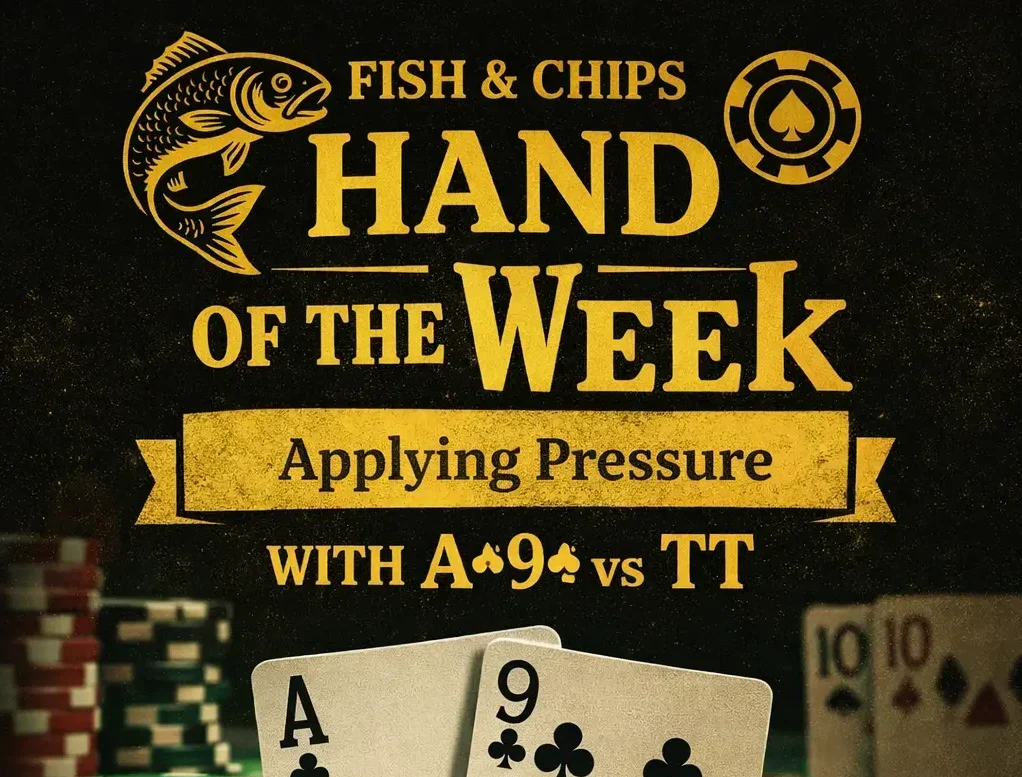
Applying Pressure with Equity (A♣9♣ vs TT)
Fish & Chips – Hand of the Week
Applying Pressure with Equity (A♣9♣ vs TT)
Game: Live $1/$2 NLH
Effective Stack: ~$170
Hero: CO
Hand: A♣9♣
Preflop
I open to $5 in the CO with A♣9♣. The button, an active player who’s been involved in a lot of pots, 3-bets to $20.
Given his tendencies—playing wide and calling down light—I decide to call and take a flop.
Preflop Analysis
This is close, but your reasoning is solid.
Against a tight player, this is often a fold. But against someone:
- 3-betting wide
- Overplaying hands
- Willing to stack off light
Calling becomes profitable.
A♣9♣ plays well:
- Has nut flush potential
- Can make strong semi-bluffs
- Has blockers to strong Ace hands
You’re not calling to hit top pair. You’re calling to win big pots with equity or aggression.
Flop
Board: J♠ 7♦ 4♣ (two clubs)
You check.
Villain bets $25.
You check-raise to $65.
Villain tanks and calls.
Flop Analysis
This is where the hand gets very well played.
Why the check-raise works
You have:
- Nut flush draw
- Ace high (overcard potential)
This is a premium semi-bluff candidate.
Your raise accomplishes multiple things:
- Builds a pot when you have strong equity
- Applies pressure to medium-strength hands
- Takes control of the hand
Against a player who:
- Bets frequently
- Calls too much
Check-raising is better than just calling. You start building fold equity immediately.
Sizing
$65 is strong and appropriate:
- You deny equity
- You make it uncomfortable for hands like TT–QQ
- You set up a turn shove nicely
Turn
Turn: 8♣
You pick up even more equity:
- Nut flush draw
- Gutshot (to a 10)
- Potential overcard if Ace is good
You shove your remaining stack.
Villain tanks and calls with TT (no club).
Turn Analysis
This is the key street.
Your shove is excellent.
Why this jam prints
You now have:
- Massive equity (flush draw + straight draw + Ace outs)
- Fold equity against hands like:
- TT
- 99
- 88
- Even some Jx
Against a thinking player, this spot is brutal:
- You represent sets (77, 44)
- You represent two pair (J8s)
- You represent strong draws that got there or improved
TT without a club is in a terrible spot.
And yet…
Live players hate folding.
What Villain Did Wrong
Calling here with TT no club is a mistake.
He is:
- Behind your value range
- Crushed by your draws
- Facing a shove with tons of pressure
Even if he thinks you’re bluffing, your bluffs have huge equity.
That’s the key concept:
You’re not bluffing. You’re semi-bluffing with outs.
Strategic Takeaways
1. Adjust to Player Type
Against tight players → fold pre
Against loose/aggressive players → call and outplay postflop
You correctly adjusted.
2. Attack with Equity
A♣9♣ is not a passive hand.
On J74cc, it becomes a power hand:
- Strong draw
- High fold equity
- Ability to barrel multiple streets
3. Plan the Hand Early
You already had the plan:
“Jam good turns”
That’s exactly how strong players think.
The 8♣ is one of the best cards in the deck for you, and you executed immediately.
4. Live Players Overcall
This hand shows a common leak:
Players call too much in big pots, even when:
- They are behind
- They block nothing
- They face max pressure
That’s where your profit comes from.
Final Thoughts
This hand is a great example of:
- Using position preflop
- Applying pressure with equity
- Executing a multi-street plan
Even though villain called, this is a winning play long term.
You’re forcing opponents into tough decisions while holding a hand that can still win when called.
That’s how you build stacks in live poker.